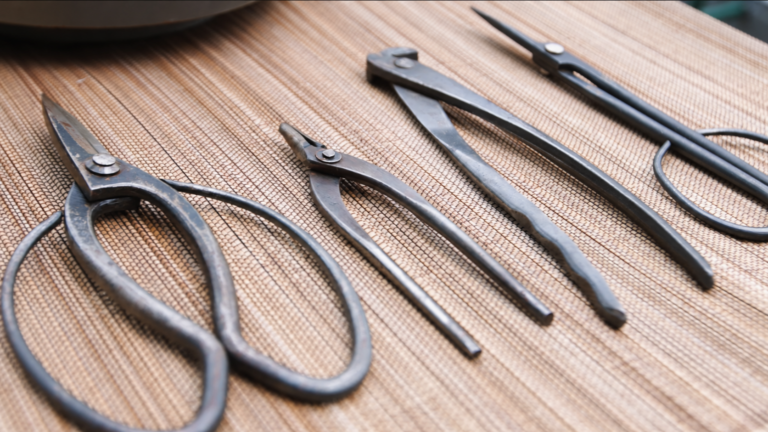
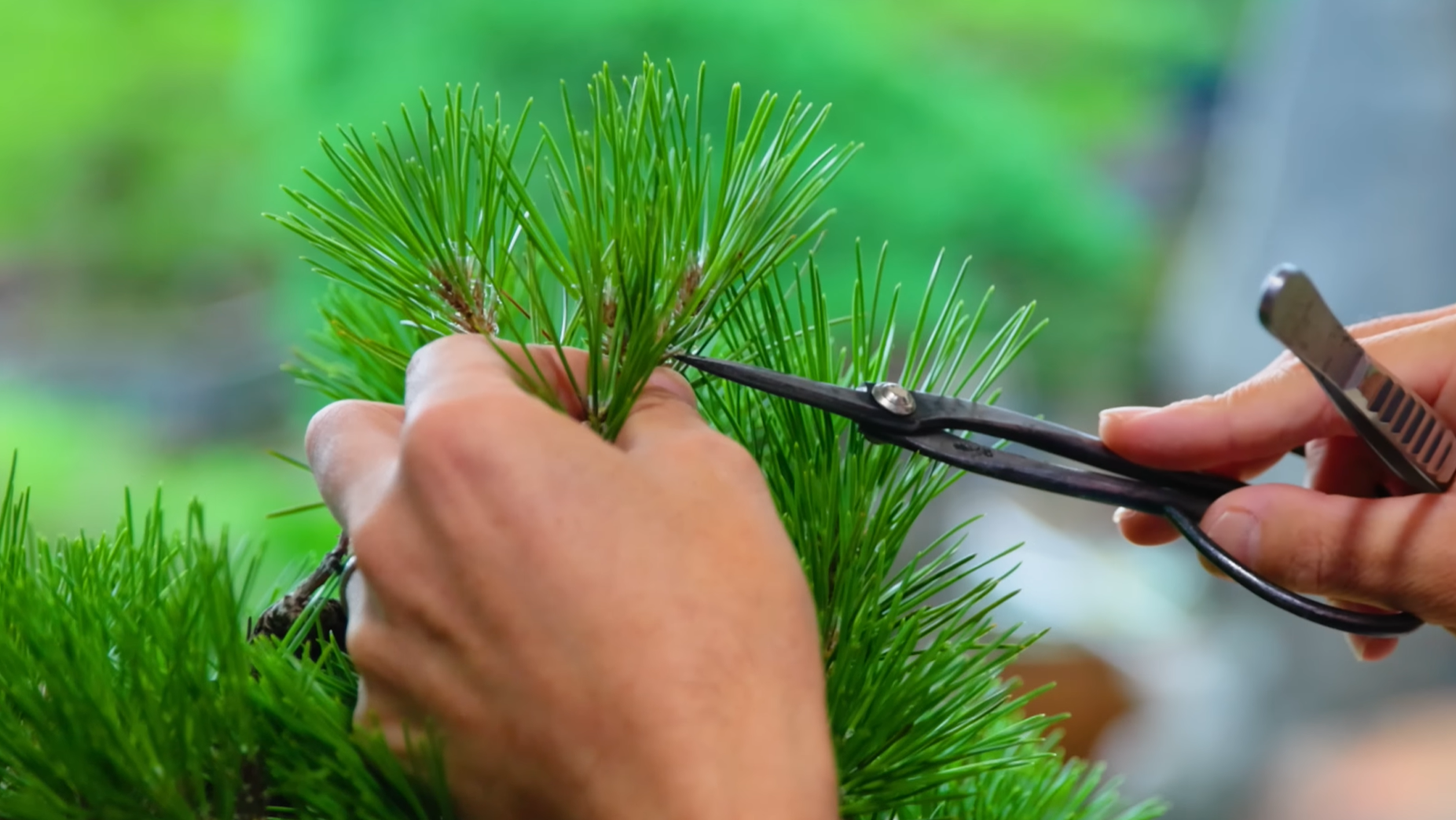
You try to slip your scissors between branches, but the blades or handles catch on the surrounding foliage. When trimming a small bud or twig, it can be difficult to see exactly where you want to cut.
This is where slim bonsai trimming scissors can help.
Fine tips are only part of the picture. Reach and a comfortable grip matter too. This guide explains how trimming scissors differ from broader bonsai scissors, what to look for when choosing a pair, and how four models compare in size and material.
This article contains affiliate links. BONSAI CLUB TOKYO may earn a commission if you purchase through them.
Uses and tool choice / What to look for / Four models compared / Care and maintenance
What Are Bonsai Trimming Scissors Used For?
Bonsai trimming scissors are used for detailed work on buds, fine branches, and leaves. Their slim tips fit between branches, making it easier to cut precisely where you intend.
Some models sold as “satsuki scissors” or “twig scissors” are also suitable for trimming buds and small branches. Satsuki scissors, for example, are not necessarily limited to use on satsuki azaleas. Look at the blade shape and intended uses as well as the name.
When to Choose Trimming Scissors
Both broader bonsai scissors and slim trimming scissors can cut small branches. The difference lies in how easily they fit into the spaces between them.
| Difficulty during pruning | What to look for |
|---|---|
| The scissors catch on surrounding branches or leaves | A slim overall shape, including the handles as well as the blades |
| It is difficult to reach inner branches | Enough reach, with a shape that fits into the space |
| The scissors are awkward to move around a small tree | A compact size that is easy to maneuver |
| A hard branch takes considerable force to cut | Switch to a tool with suitable cutting capacity rather than forcing slim scissors |
Slim trimming scissors are useful for small bonsai and dense branching, and can be easy for beginners to handle. Choose a size that fits your hand and a shape that lets you guide the tips to the place you want to cut.
To compare scissors with different handle and blade shapes, see our guide to choosing bonsai scissors, with a comparison of three models.
Four Things to Consider When Choosing Trimming Scissors
1. Can the Blades Reach the Cutting Point?
Start by looking at the spacing between branches on the trees you usually work on.
Even with fine tips, the base of the blades or the handles may catch as you move farther into the tree. When looking at product photos, consider the entire shape of the scissors, not just the tips, and how far they will fit between branches.
2. Do You Need Maneuverability or Greater Reach?
Compact scissors are an option when you need to work in a limited space. To reach farther into a tree, however, you may need a longer pair.
Overall length alone does not determine ease of use. Two pairs of the same length can have different blade and handle proportions, changing both their reach and how they feel in your hand.
3. Can You Open and Close Them Comfortably?
Detailed pruning involves repeatedly opening and closing the scissors while checking each cutting point. Choose handles that accommodate your fingers comfortably and allow you to keep the tips steady.
Weight is useful for comparison, but do not choose on lightness alone. Consider the handle shape and how your fingers fit as well.
4. Material and Maintenance
Steel scissors need dirt and moisture removed after use and protection against rust during storage. If rust resistance is a priority, stainless steel and other rust-resistant options are worth considering.
Even rust-resistant materials should not be left dirty or wet. Weigh the maintenance you can keep up with against the price at the time of purchase.
Four Models for Detailed Bonsai Care
A compact pair, one for reaching inner branches, or a more rust-resistant option: compare these models according to the work you need them to do.
| Model | Overall length | Why consider it? |
|---|---|---|
| Kikuwa Dojin Satsuki Scissors, Small 1079 | Approx. 150 mm | A compact, slim shape |
| Kikuwa Bonsai Trimming Scissors 2056 | Approx. 180 mm | Pruning and bud trimming farther inside the tree |
| Kikuwa Stainless Steel Bonsai Trimming Scissors 5019 | Approx. 180 mm | Rust resistance and lighter weight |
| Kaneshin Twig Scissors, Large No. 35A | 180 mm | Detailed work on small to medium-sized bonsai |
Kikuwa Dojin Satsuki Scissors, Small 1079 — A Compact Option
A compact pair measuring approximately 150 mm overall and weighing about 83 g. Made from S58C steel, these scissors can trim shoots and small branches on bonsai other than satsuki azaleas as well.
Their slim overall shape also suits work on small bonsai. Consider them if scissors around 180 mm long feel awkward to maneuver. Check the size of the handles before buying, too.
Kikuwa Bonsai Trimming Scissors 2056 — For Reaching Inner Branches
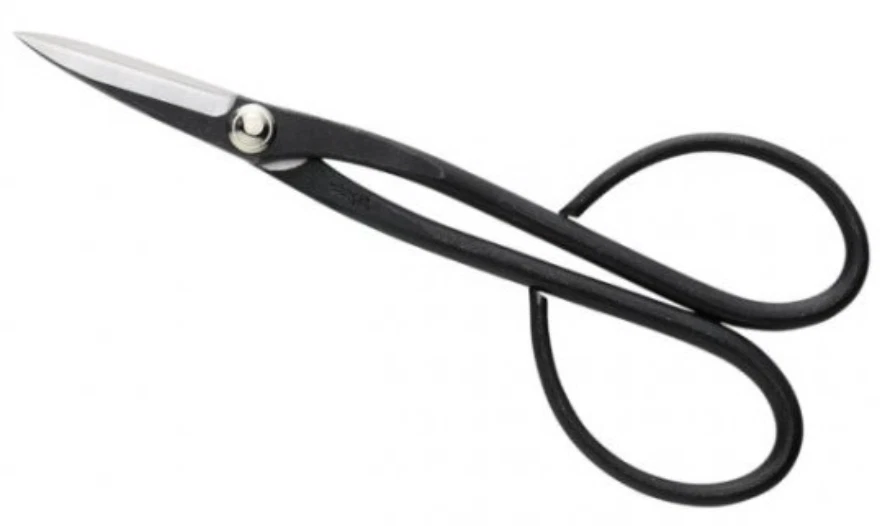
Approximately 180 mm long and 102 g in weight, this model uses YCS3 steel and is suited to pruning and bud trimming inside the branching structure.
It is an option if you want a longer pair than the compact 1079. To work inside the tree as well as around its outer branches, compare the overall shape, including the handles.
Check price and availability on eBay
Kikuwa Stainless Steel Bonsai Trimming Scissors 5019 — For Greater Rust Resistance
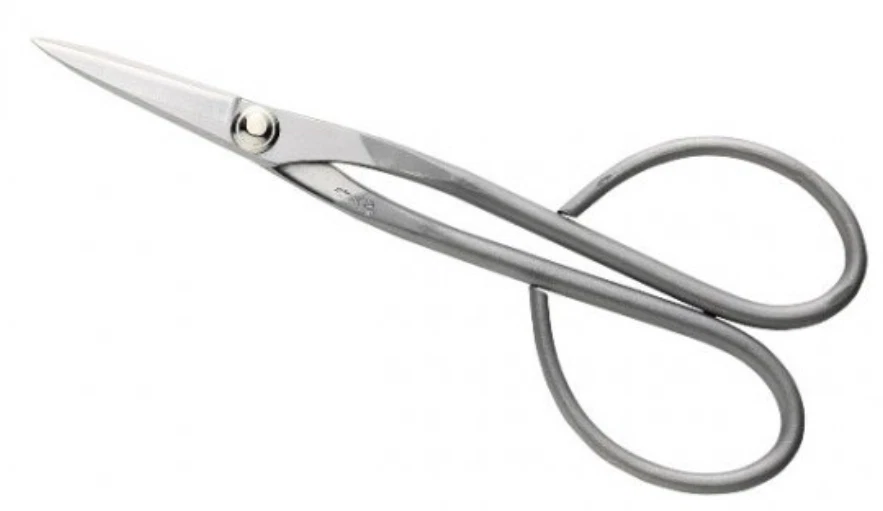
This model measures approximately 180 mm overall and weighs about 96 g. It uses SLD steel for rust resistance.
It is roughly the same length as the 2056, but differs in material and weight. Consider it if you want a pair around 180 mm long and place a priority on rust resistance. As with other scissors, clean and dry it after use.
Check price and availability on eBay
Kaneshin Twig Scissors, Large No. 35A — For Detailed Work on Small to Medium-Sized Bonsai
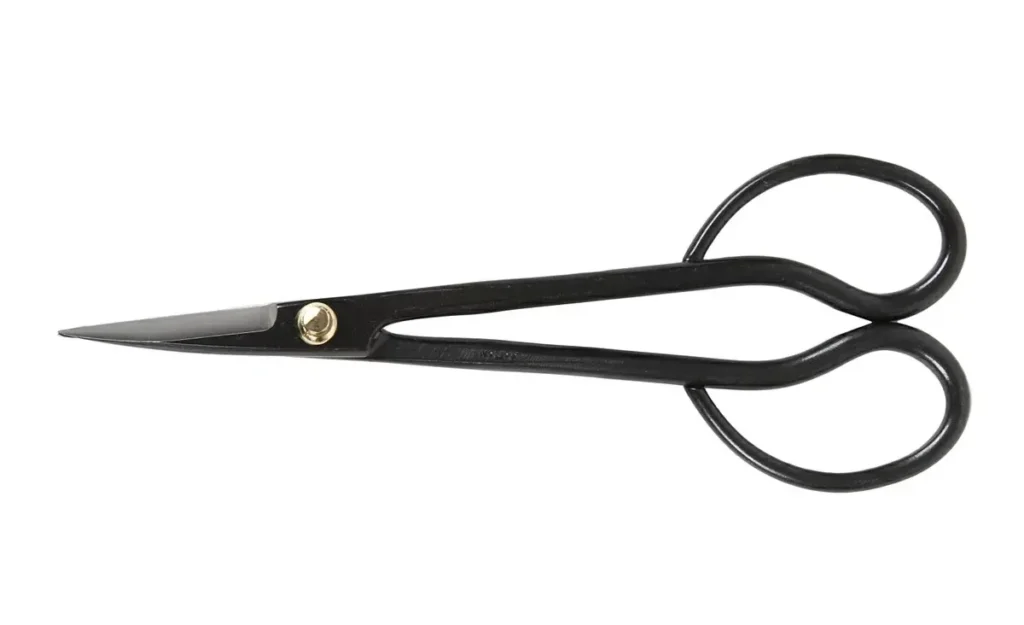
With an overall length of 180 mm and a blade length of 39 mm, this model is intended for small to medium-sized bonsai. It can be used for trimming small branches, leaves, and buds.
Although the product name includes “Large,” this does not mean it is specifically for large bonsai or thick branches. When choosing scissors for detailed work on branches and foliage, consider the blade length and how comfortably the handles fit your hand.
Check price and availability on eBay
How to Protect Fine Blade Tips
Avoid forcing a cut or twisting the scissors while the blades are between branches. Use an appropriate tool for thick or hard branches.
After use, remove sap and dirt, then wipe away moisture. Protect rust-prone steel with a suitable blade oil and store the scissors in a dry place. Use wire cutters for cutting wire.
Start with the Places Your Current Scissors Struggle to Reach
The smallest or slimmest pair is not always the best choice.
Do your scissors catch on nearby branches, fail to reach far enough, or feel awkward to maneuver? Identifying the difficulty helps you decide which shape you need.
Consider the 1079 for compact handling, the 2056 for work farther inside the tree, and the 5019 for rust resistance. For detailed work on small to medium-sized bonsai, the Kaneshin No. 35A is another option to compare.
Choose a pair that suits your tree’s branching structure and the size of your hand, so you can guide the tips into position comfortably.